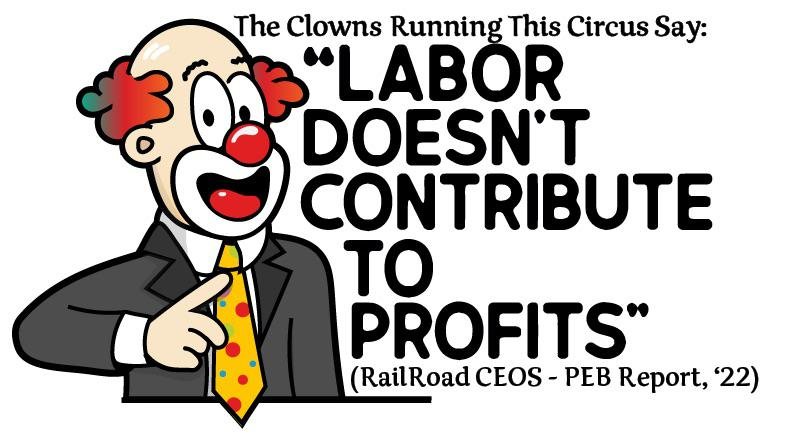
The prospect of a railroad strike in August-December 2022 generated a lot of fear of a prolonged stoppage of our entire railroad industry. Jason Miller, at Michigan State, outlines how dire a prolonged stoppage of our railroad industry would be on the American economy, and especially emphasized trucks’ inability to meet the volume of of goods that are daily carried by railroads. And, their workers had good reasons to walk off the job: The inhumane working conditions created by Shareholder Primacy practices of PSR, which includes lack of sick leave, punitive policies for workers who took off for a family emergency, and the huge cuts in the work force which caused forced overtime and family issues.
In December, President Biden signed a bill forcing the workers to accept the contract and even made their strike illegal. This historical strike of railroad workers was forced to end and many people outside of railroading don’t remember it except for one outrageous paragraph statement below from the “Carriers'” (railroads) loud and clear declaration based in their belief in the Shareholder Primacy ideology:
“The Carriers maintain that capital investment and risk are the reasons for their profits, not
any contributions by labor. The Carriers further argue that there is no correlation historically
between high profits and higher compensation, either in the freight rail industry or more
generally. To the contrary, one of the Carriers’ experts maintained that the most profitable
companies are not those whose compensation is the highest. The Carriers assert that since
employees have been fairly and adequately paid for their efforts and do not share in the downside
risks if the operations are less profitable, then they have no claim to share in the upside either.”
Presidential Emergency Board No. 250 – Report and Recommendations. p. 32. August 16, 2022 (emphasis mine).
Shareholder Primacy views Labor as a variable expense to be minimized. The first thing we need to understand is that it’s the shareholders and hedge funds who put up the capital investment and risk for the railroads. Shareholder Primacy doctrine sees workers as having NO legitimate stake in the railroad company, because the railroad company serves no other purpose but the creation of shareholder value and wealth. Shareholders and investors are “paying into” the railroad operation and and are “taking the risks” with their investments. From the view of Shareholder Primacy the losses are taken by the shareholders and investors, not the employees. Labor has no part in the railroad company other than being an expense that needs to be managed and reduced, like managing the number of railcars and locomotives that are online. And as soon as Labor cuts into the profits of shareholders, the labor is managed and cut.
[T]he highly profitable rail operators can easily afford to offer paid time off, but they choose instead to use their revenue to buy back stocks and offer large dividends to shareholders. By pre-cancelling the strike, the federal government effectively sides with the employers and wealthy shareholders at the expense of the workers. These are not the actions of a “pro-labor” president.
Steve Flamisch, Rutgers Today, December 1, 2022
In a Nutshell: Why doesn’t Labor Contribute to Profits in Shareholder Primacy?
Answer: Because labor is an expense that needs to be cut to create “free cash” for shareholders, and be carefully managed so as not to “leak” cash away from the shareholders.
References for Reading.
Bahn, Kate and Carmen Sanchez Cumming. 2006. How corporate governance strategies hurt worker power in the United States. The Washington Center for Equitable Growth. September 6.
Brennan, Louis. 2018. How shareholder profits conquered capitalism – and how workers can win back its benefits for themselves. The Conservation. October 5.
Fligstein, Neil; Shin, Taek-Jin. 2006. Shareholder Value and the Transformation of American Industries, 1984-2001. Institute for Research on Labor and Employment. Working Paper Series Banner. September.
Karlsson Kristina and Lenore Palladino. 2018. Corporations should invest in workers – not just shareholders. Equal Times. November 29.
O’Callahan, Ted. Is the Era of Shareholder Primacy Over? Yale Program. September 11th
Palladino, Lenore. 2018. Why Workers On Corporate Boards Just Makes Sense. Roosevelt Institute. August 14.
Palladino, Lenore. 2025. To restore democracy, end shareholder primacy at U.S. corporations and on Wall Street. The Washington Center for Equitable Growth. September 11.
Press Release. 2018. New Report Takes Aim at Myths About Shareholders, Describes Harm Their Power Causes. Roosevelt Institute. June 19.
Samuelson, Judy. 2022. The Impact of Shareholder Primacy: What it Means to put the Stock Price First. Aspen Institute. March 16.
