
This question might seem dumb, but it’s very important to see how hedge funds and Wall Street types would answer this question.
The defining question is: What do our railroads exist for? To increase “shareholder value” for shareholders and do the bidding of hedge fund activists? Or is it to serve our national economy by serving the business customers that need rail transportation to ship their finished products, chemicals, the harvest from farms, autos, clothes, lumber, and more, that make our daily lives possible? The fact is, American Railroads are the best transportation on Earth to move commodities, like coal, lumber, and grains, in large amounts efficiently over long distances. Without our Railroads functioning properly, vital things we need to live, including foodstuffs, would be very expensive or unavailable altogether! To mess with our railroads is to mess with our national security! According to the American Association of Railroads (AAR), rail is the backbone of the American economy:
“In 2023, rail generated $233.4 billion in economic output, with Class I railroads investing $26.8 billion to modernize infrastructure, enhance safety, and improve reliability. Every $1 invested drives $2.50 in economic activity, and every rail job supports nearly four more across manufacturing, logistics, and technology. With 153,000 direct employees and 749,000 supported jobs nationwide, rail delivers high-paying careers, contributes $14.1 billion in retirement benefits, and remains a pillar of America’s competitiveness and resilience.”
E. Hunter Harrison’s Pride: Precision Scheduled Railroading and Shareholder Primacy
However, there is a war going on for the control of our railroads, with two models of railroad governance that reflect the purposes our railroads serve. The first model is Shareholder Primacy, which was formed from the notions of “shareholder owners” and “shareholders first.” These notions of corporate governance were expressed by Milton Friedman in his September 13, 1970, article in the New York Times. Friedman argued that corporations exist only for the profits they bring in for the “owners,” the shareholders. The only stakeholder is the shareholder, and the first concern of a corporation must revolve around “increasing shareholder value.”
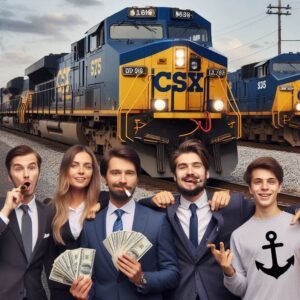
The railroad is just for shareholders, and it’s run just for shareholders. Whenever you see an activist hedge fund or shareholders’ group burrowing itself into a railroad like CSX, the goals are short-term ones, and they only have shareholders in mind. We see the extremes of PSR, with two-mile trains, layoffs of critical workers, and more derailments, like East Palestine. The railroad becomes shareholder-centered and focused only on the operating ratio, stock price, and CEOs and directors who are firm believers in Shareholder Primacy. There is the possibility of a forced merger that no one wants pushed on the target railroad.
Shareholder Primacy in Railroading is promoted fully by Wall Street, Ancora Holdings Group, Mantle Ridge, and their picks for CEO and directors for railroad corporate boards. E. Hunter Harrison proudly told the world about his strong belief in shareholder primacy and his brand of Precision Scheduled Railroading (PSR) as a part of it during the October 2017 STB hearing that shamefully called out CSX for its service failures (see pages 32-33 of Oct. 11, 2017 STB hearing transcript). Harrison told the STB and everyone else at the hearing that he “was proud of what they have achieved at CSX” with his PSR model, even as the whole STB hearing was about how his PSR model had crippled CSX!
We must do better to protect our American Railroading, and we can, with the Stakeholder Inclusion model.
We should believe that protecting the backbone of our economy is far more important than some theories about shareholder primacy and “adding shareholder value.” Our railroad infrastructure is regarded as having national security importance and should be protected from shareholder activism! Our railroads are a national treasure and a part of American national history and heritage. When activist shareholder groups like Ancora and Mantle Ridge burrow into our railroads, they are driven into failure for the railroad’s other stakeholders. Shareholder Primacy actually denies the real purposes of America’s freight railroads and replaces them with “increasing shareholder value” for the shareholder “owners.”
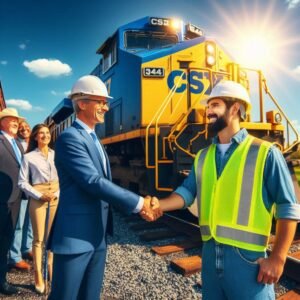
The Stakeholder Capitalism (Inclusion) model recognizes that our railroads have an important place in providing necessary rail transportation service to the American economy. Shareholders are also stakeholders, and they will be much better off if the railroad has a long-term growth plan. The railroad will consider the needs of customers and shippers as a daily goal, as other businesses in other industries have to do to grow and remain in business. There will be enough locomotives and railcars online to cover all customers’ needs…and enough respected and valued employees to service those needs. Other stakeholders of a railroad can be identified and included, such as the communities that are present on the railroad’s network.
When a company does right for its many stakeholders, especially publicly, it can create a good image for the company. Before he was forced out by Ancora, Joe Hinrichs was turning CSX into a superstar company where employees were highly valued, respected and, in turn, gave great service to CSX’s customers. Part of Mr. Hinrichs’ achievements in the transformation of CSX into a superstar was the investment in expanding the Howard Street intermodal tunnel and the rebuilding of 60 miles of tracks after a hurricane hit CSX’s Blue Ridge Subdivision. Before all that was done, Mr. Hinrichs won Railway Age’s 2025 Railroader of the Year Award, a coveted award for railroad CEOs. Hinrichs’ ouster by CSX’s weak-spined board of directors is a demonstration of how activist shareholder groups, like Ancora, hold a Sword of Damocles over our Railroads and force their loyalty to failed models and PSR and the pursuit of the mythical “shareholder value.”
All of us who are Friends of the Railroads need to counter with the real purpose of our Railroads, and it’s not “increasing shareholder value!”
Further Reading
- Importance of our Railroads in America
- Why are railroads still important in the current era? Freightwaves. December 28, 2019
- Railroad 101. Association of American Railroads.
- Freight railroads power America’s economy. Association of American Railroads.
- Common Carrier Obligations of Freight Railroads
- What does the common carrier obligation mean for US railroads? Freightwaves. May 28, 2022
- Railroads Common Carrier Obligations. United States Department of Agriculture.
- Senate bill aims to improve rail service by addressing common carrier obligation. Trains! June 20, 2025.
- Code of Federal Regulations. 49 U.S. Code § 11101.
- USCODE-2017-title49-subtitleIV-partA.
- CSX’s trials and tribulations with E. Hunter Harrison
- Harrison under fire as STB letter confirms trouble at CSX. SupplyChainDive. July 28, 2017
- Harrison’s Letter to the Rail Customer Coalition. August 16, 2017.
- Harrison to CSX shippers: “We apologize.” Railway Age. August 01, 2017
- Hunter Harrison responds to Railway Age. July 28, 2017.
- Shareholder v. Stakeholder – What’s the Difference? Investopedia. April 26, 2025
- The Myth That Shareholders Are Always Investors: Challenging the Paradigm of Shareholder Primacy. Roosevelt Institute. November 21, 2024.
- The Dumbest Business Idea Ever. The Myth of Maximizing Shareholder Value. Evonomics.
